Est. 2020

Company registered in England

NG2

Nottingham showroom & workshop

UK

Sales & service enquiries

  • Fast dispatch
  • Warranty-backed
  • Workshop ready
  • Lower-impact travel

Your E-Bike Questions Answered

Find answers to commonly asked questions about electric bicycles, accessories, maintenance, and our services at Power Ride Ltd. Our comprehensive FAQ section addresses inquiries about battery life, motor performance, charging procedures, legal requirements for e-bikes in the UK, and much more. We've compiled this resource based on customer questions and our extensive experience in the industry to help you understand the essentials of electric bicycle ownership and operation.

Can't Find Your Answer?

If you can't find the information you're looking for in our FAQ section, our customer service team is always ready to assist. Feel free to contact us directly for personalized assistance with your specific questions or concerns.

Contact Us

E-Bike Resources

Explore our blog and knowledge base for in-depth articles, guides, and tutorials about electric bicycles. We regularly publish content to help you get the most out of your e-bike experience, from maintenance tips to riding techniques.

Visit Our Blog

FAQ Categories

An electric bicycle (e-bike) is a conventional bicycle equipped with an electric motor that provides assistance when pedaling. The key components of an e-bike include:

  • Electric Motor: Typically located in the hub of either wheel (hub motor) or at the pedal crank (mid-drive motor)
  • Battery: Usually lithium-ion, mounted on the frame or integrated within it
  • Controller: The "brain" that regulates power from the battery to the motor
  • Sensor System: Detects when and how hard you're pedaling to provide appropriate assistance
  • Display/Control Unit: Allows you to select assistance levels and monitor battery status

When you pedal an e-bike, sensors detect your pedaling and activate the motor to provide assistance, making it easier to maintain speed and climb hills. Most e-bikes offer multiple levels of assistance, allowing you to choose how much help you want from the motor. The motor only provides assistance up to a certain speed (typically 15.5 mph/25 kph in the UK for legal road use), after which you rely solely on your own pedaling power.

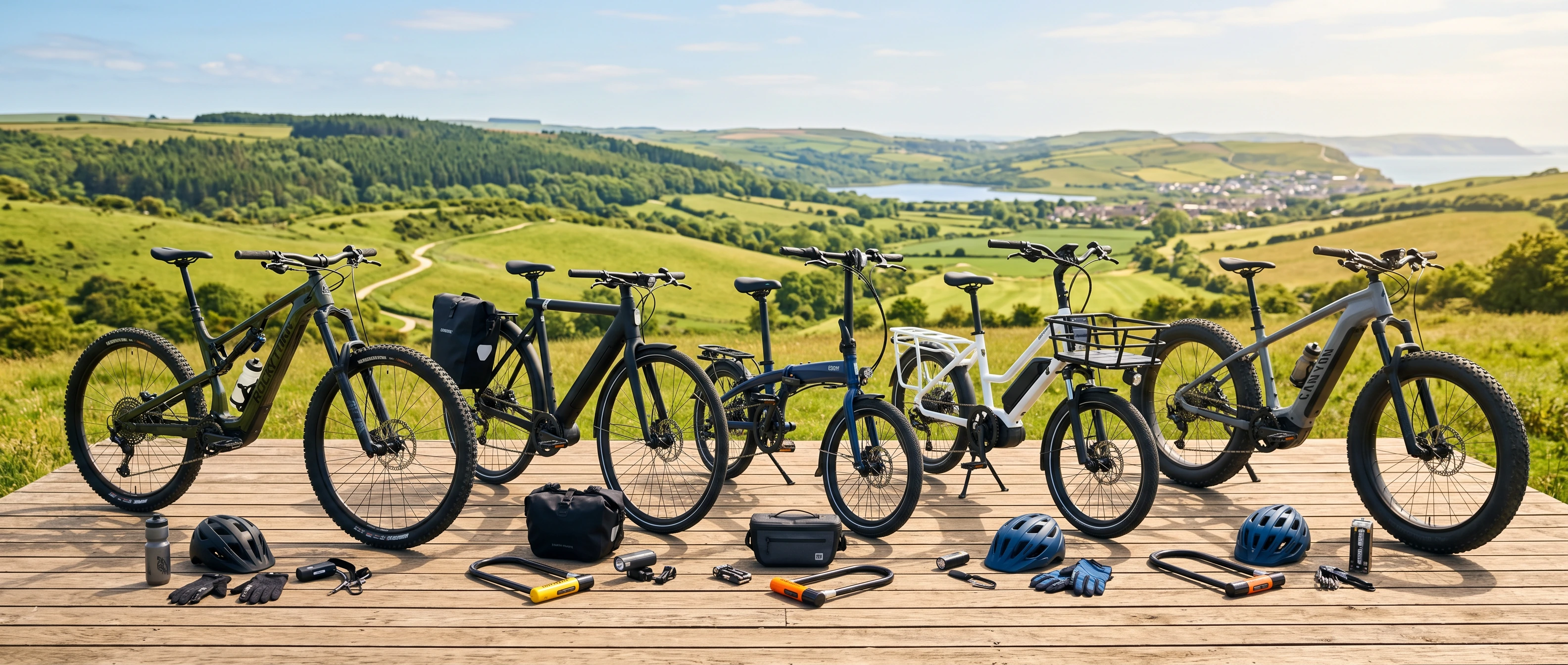
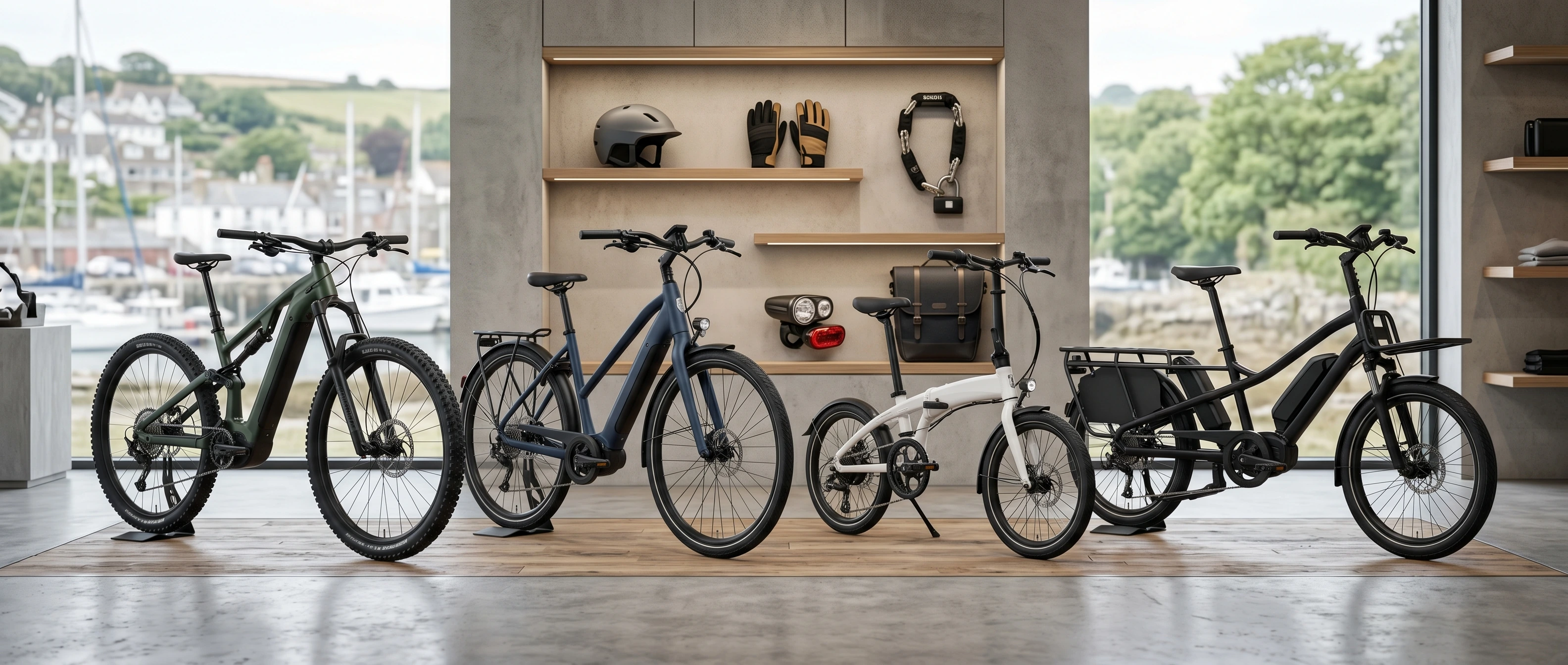
Electric bicycles come in various types designed for different riding purposes:

  • City/Commuter E-Bikes: Designed for urban environments with comfortable upright riding positions, integrated lights, fenders, and racks. These typically prioritize comfort and practicality for daily transportation.
  • Electric Mountain Bikes (eMTBs): Feature robust frames, suspension systems, and powerful motors for off-road trails and rough terrain. They're built to handle steep climbs and technical descents.
  • Folding E-Bikes: Compact and portable designs that can be folded for easy storage and transport. Ideal for mixed-mode commuting and those with limited storage space.
  • Cargo E-Bikes: Built for hauling loads with extended frames, reinforced components, and powerful motors. Available in various configurations including front-loading, rear-loading, and longtail designs.
  • Road E-Bikes: Lightweight with drop handlebars and efficient riding positions, designed for speed and distance on paved surfaces.
  • Step-Through E-Bikes: Feature low-entry frames that make mounting and dismounting easier, particularly beneficial for riders with limited mobility.
  • Fat Tire E-Bikes: Equipped with extra-wide tires (4" or wider) for enhanced stability and traction on challenging surfaces like sand, snow, and loose gravel.

Each type offers specific advantages depending on your riding environment, physical needs, and transportation goals. At Power Ride Ltd, we can help you determine which style best suits your specific requirements.

The range of an electric bicycle varies significantly based on several factors:

  • Battery Capacity: Measured in watt-hours (Wh), higher capacity batteries generally provide longer range. Common capacities range from 300Wh to 700Wh, with some premium models offering up to 1000Wh.
  • Assistance Level: Higher assistance levels consume more battery power. Using eco or low assistance modes can significantly extend range compared to using maximum power.
  • Rider Weight: Heavier combined weight (rider + cargo) requires more energy to move, reducing range.
  • Terrain: Hilly routes consume substantially more battery than flat terrain. Climbing steep hills on high assistance can quickly deplete battery reserves.
  • Weather Conditions: Headwinds, cold temperatures, and wet surfaces can all reduce range.
  • Riding Style: Frequent stops and starts consume more energy than maintaining steady speeds.
  • Tire Pressure: Properly inflated tires reduce rolling resistance and improve efficiency.

As a general guideline:

  • Small capacity batteries (300-400Wh): 20-40 miles (32-64 km)
  • Medium capacity batteries (400-600Wh): 30-60 miles (48-96 km)
  • Large capacity batteries (600-800Wh): 40-80 miles (64-128 km)
  • Extra-large capacity batteries (800Wh+): 50-100+ miles (80-160+ km)

These ranges assume moderate assistance levels on relatively flat terrain. For more accurate range estimates for specific models, please speak with our staff who can provide information based on real-world testing and customer feedback.

Hub motors and mid-drive motors represent the two primary electric drive systems for e-bikes, each with distinct characteristics:

Hub Motors

Hub motors are built into either the front or rear wheel hub.

Advantages:

  • Generally more affordable
  • Simpler design with fewer moving parts
  • Less wear on the bike's drivetrain
  • Quieter operation
  • Can often be used with throttle control (where legally permitted)

Limitations:

  • Cannot leverage the bike's gearing system
  • Less efficient on steep hills
  • Can make wheel removal more complicated for maintenance
  • Weight distribution is concentrated in the wheel, potentially affecting handling
Mid-Drive Motors

Mid-drive motors are integrated with the bike's crankset (where the pedals attach).

Advantages:

  • Utilizes the bike's gearing system for optimal efficiency
  • Superior performance on steep hills and varied terrain
  • Better weight distribution and center of gravity
  • Often features more advanced torque sensors for natural-feeling assistance
  • Easier wheel removal for maintenance or flat repairs

Limitations:

  • Typically more expensive
  • Places more wear on the chain, cassette, and derailleur
  • Usually louder than hub motors
  • More complex system for repairs

The best choice depends on your riding environment, budget, and preferences. Mid-drive systems are generally preferred for hilly terrain and performance-oriented riding, while hub motors offer good value for flatter commuting routes. Our staff can help you evaluate which system would best suit your specific needs.

Electric bicycles are actually easier to ride than conventional bicycles for most people. If you can ride a traditional bicycle, you'll find an e-bike even more accessible. The electric assistance reduces the effort required to pedal, especially when starting from a stop, climbing hills, or riding against headwinds.

Here are some key points about riding an electric bicycle:

  • Familiar Controls: E-bikes operate just like regular bicycles—you pedal, steer, and brake in the same way. The only addition is simple controls to adjust assistance levels.
  • Adjustable Assistance: You can choose how much help you want from the motor, from minimal assistance to significant power boost.
  • Builds Confidence: The assistance helps overcome challenges that might intimidate some riders, such as hills or longer distances.
  • Weight Considerations: E-bikes are heavier than conventional bicycles (typically 40-70 lbs/18-32 kg), which is most noticeable when carrying the bike or riding without power assistance.
  • Learning Curve: There's a brief adjustment period to get used to the power delivery, but most riders adapt within minutes.

For those new to cycling or returning after a long break, e-bikes can be particularly beneficial as they reduce physical barriers to entry. The assistance allows riders to gradually build fitness and confidence while enjoying longer rides than might otherwise be possible.

At Power Ride Ltd, we offer test rides and orientation sessions for new e-bike owners to ensure you're comfortable with your bicycle's features and handling characteristics before heading out on the road.

Charging time for e-bike batteries depends primarily on the battery capacity and the charger's output. Most e-bike batteries take between 3-6 hours to charge completely from empty, though this can vary significantly based on several factors:

  • Battery Capacity: Larger capacity batteries (measured in watt-hours or Wh) take longer to charge. A 500Wh battery will typically take longer to charge than a 300Wh battery using the same charger.
  • Charger Output: Standard chargers typically output 2-4 amps. Higher amperage chargers can reduce charging time but may not be recommended for all battery systems.
  • Starting Charge Level: Charging from 20% to 100% will take less time than charging from completely empty.
  • Battery Age and Condition: Older batteries may charge more slowly as their capacity and efficiency decrease over time.
  • Temperature: Charging is most efficient at room temperature (15-25°C). Very cold or hot environments can extend charging times and potentially damage the battery.

Approximate charging times for common battery sizes with standard chargers:

  • 300-400Wh battery: 2-4 hours
  • 500-600Wh battery: 3-5 hours
  • 700-800Wh battery: 4-7 hours

Many modern e-bike batteries feature smart charging systems that adjust the charging rate to optimize battery health. These systems typically charge rapidly up to about 80-90% capacity, then slow down for the remaining charge to protect battery cells.

For specific charging times for your e-bike model, refer to the manufacturer's documentation or ask our technical staff for guidance.

E-bike batteries typically last between 3-5 years or 500-1,000 charge cycles, whichever comes first. A charge cycle is counted when you use 100% of the battery's capacity, which could be one full discharge or multiple partial discharges that add up to 100%.

Several factors influence battery lifespan:

  • Battery Quality: Premium batteries from reputable manufacturers generally last longer than budget alternatives.
  • Usage Patterns: Frequent deep discharges (regularly using the battery until it's nearly empty) can shorten lifespan.
  • Charging Habits: Optimal charging practices involve keeping the battery between 20% and 80% for regular use, avoiding both complete discharge and constant 100% charging.
  • Storage Conditions: Batteries stored in extreme temperatures (particularly heat) degrade faster. Ideal storage is at 40-60% charge in cool, dry conditions.
  • Temperature During Use: Operating in very hot or cold conditions accelerates battery degradation.
  • Battery Management System (BMS): Higher quality e-bikes have sophisticated BMS that protect against overcharging, over-discharging, and temperature extremes.

Signs that your battery may need replacement include:

  • Significantly reduced range (more than 30% less than when new)
  • Difficulty holding a charge
  • Inconsistent power delivery
  • Physical swelling or damage to the battery case

When a battery does need replacement, it's important to use a compatible battery from the original manufacturer or a reputable alternative. Our service department can assess your battery's condition and advise on replacement options when necessary.

Most electric bicycles feature removable batteries, though designs vary significantly between models. Removable batteries offer several advantages:

  • Convenient Charging: You can bring the battery indoors to charge while leaving the bike in a garage or storage area.
  • Security: Removing the battery when parking in public reduces the risk of theft and vandalism, as the e-bike cannot be ridden with power assistance without the battery.
  • Extended Range: Some riders carry a spare battery for longer journeys, effectively doubling their potential range.
  • Weight Reduction: Removing the battery (which can weigh 2-4 kg) makes the bike lighter for transport or carrying up stairs.
  • Storage: For long-term storage, removing the battery allows for optimal storage conditions.

Common battery mounting systems include:

  • Frame-Integrated: The battery sits within or on the down tube of the frame, typically secured with a lock.
  • Rack-Mounted: The battery is attached to or integrated into a rear rack.
  • External Frame Mount: The battery attaches to the outside of the frame, often where a water bottle would normally be mounted.

Some premium e-bikes feature fully integrated, non-removable batteries that are built into the frame for aesthetic and aerodynamic purposes. These designs require bringing the entire bicycle to a power source for charging.

When purchasing an e-bike, we recommend considering how and where you'll charge it to ensure the battery system meets your needs. Our staff can demonstrate the battery removal and installation process for any model you're interested in.

Yes, most modern electric bicycles are designed to be used in rainy conditions. Quality e-bikes have water-resistant components that protect the electrical systems from normal weather exposure. However, there are important considerations and precautions to keep in mind:

Water Resistance Ratings:

  • Many e-bikes have IP (Ingress Protection) ratings that indicate their level of water resistance. Common ratings include:
  • IPX4: Protected against water splashes from all directions
  • IPX5: Protected against low-pressure water jets
  • IPX6: Protected against powerful water jets
  • IPX7: Protected against temporary immersion (up to 1 meter for 30 minutes)

Riding in Rain:

  • Riding in light to moderate rain is generally safe for water-resistant e-bikes
  • Adjust your riding style for wet conditions (slower speeds, gentle braking, avoiding puddles)
  • Be aware that wet conditions reduce traction and increase stopping distances

After-Ride Care:

  • Wipe down the bike after riding in wet conditions, paying special attention to electrical connection points
  • Allow the bike to dry completely before charging
  • Regularly lubricate the chain and mechanical components to prevent rust

Important Cautions:

  • Avoid submerging any part of the e-bike in water (deep puddles, streams, etc.)
  • Never use high-pressure water (pressure washers) to clean your e-bike
  • Be particularly careful around the battery connection points, display unit, and motor

While most e-bikes can handle rain, it's worth noting that different models have varying levels of water resistance. Premium e-bikes typically offer better weather protection than budget models. If you frequently ride in wet conditions, we recommend selecting a model with appropriate weather resistance and considering fenders to reduce water spray.

For specific information about your e-bike's water resistance, consult your owner's manual or contact our service department.

Maximizing your e-bike battery's lifespan requires attention to charging habits, storage conditions, and usage patterns. Follow these best practices to extend your battery's useful life:

Optimal Charging Practices
  • Avoid Complete Discharges: Try not to regularly run the battery completely flat. Lithium-ion batteries prefer partial discharges.
  • Avoid Constant 100% Charging: For daily use, charging to 80-90% is ideal rather than always charging to 100%.
  • Use the Original Charger: Always use the charger that came with your e-bike or an approved replacement.
  • Charge at Room Temperature: Charging in extreme temperatures (below 0°C or above 40°C) can damage the battery.
  • Unplug When Full: Don't leave the battery connected to the charger for extended periods after reaching full charge.
Storage Recommendations
  • Ideal Charge Level: For long-term storage (more than a few weeks), keep the battery at approximately 40-60% charge.
  • Temperature Control: Store in a cool, dry place (10-20°C is ideal). Avoid storage in freezing conditions or hot environments like attics or garages in summer.
  • Periodic Maintenance: If storing for several months, check the battery every 6-8 weeks and recharge to 40-60% if needed.
  • Remove from Bike: For extended storage, consider removing the battery from the bicycle.
Usage Tips
  • Use Lower Assistance Levels: When possible, use lower power settings to reduce battery strain.
  • Maintain Proper Tire Pressure: Underinflated tires increase rolling resistance and drain the battery faster.
  • Regular Maintenance: Keep the drivetrain clean and well-lubricated to reduce motor load.
  • Smooth Riding: Avoid frequent hard acceleration and unnecessary braking.
  • Weight Management: Minimize unnecessary weight in panniers or baskets.
Additional Considerations
  • Battery Management System: Quality e-bikes have sophisticated BMS that help protect the battery. Trust these systems and follow manufacturer guidelines.
  • Software Updates: Keep your e-bike's firmware updated if applicable, as updates may include battery optimization improvements.
  • Professional Check-ups: Consider having your battery diagnostically checked annually by our service department.

By following these guidelines, you can significantly extend your battery's lifespan, potentially adding years of service before replacement becomes necessary.

Regular maintenance is essential for keeping your electric bicycle performing safely and efficiently. We recommend the following service schedule:

Regular Home Maintenance (Every 2-4 Weeks or 100-200 miles)
  • Check tire pressure and inflate to recommended PSI
  • Clean and lubricate the chain
  • Inspect brake pads for wear
  • Test brake performance
  • Check that all bolts and quick-releases are secure
  • Wipe down the frame and components
  • Inspect tires for wear or embedded objects
Basic Professional Service (Every 6 Months or 500-750 miles)
  • Drivetrain inspection and adjustment
  • Brake system inspection and adjustment
  • Wheel truing and spoke tension check
  • Headset and bottom bracket inspection
  • Battery connection check
  • Motor mount security verification
  • Software/firmware updates if applicable
  • Basic electrical system diagnostics
Comprehensive Professional Service (Annually or 1,500-2,000 miles)
  • Complete electrical system diagnostics
  • Battery health assessment
  • Motor inspection and service (if applicable)
  • Drivetrain deep clean and component wear assessment
  • Brake system overhaul (pad replacement, hydraulic fluid replacement if needed)
  • Bearing systems inspection and regreasing
  • Suspension service (if applicable)
  • Comprehensive safety check of all components

Additional Service Considerations:

  • Riding Conditions: More frequent servicing is recommended if you regularly ride in wet, muddy, or dusty conditions.
  • Usage Intensity: Commuters who ride daily or riders who tackle challenging terrain should consider more frequent check-ups.
  • Warning Signs: Unusual noises, decreased performance, or inconsistent electrical assistance are indicators that immediate service may be needed, regardless of the maintenance schedule.

At Power Ride Ltd, we offer various service packages tailored to different e-bike types and usage patterns. Our technicians are certified to work on all major e-bike systems and can provide model-specific maintenance to keep your electric bicycle in optimal condition.

Yes, you can perform certain maintenance tasks on your electric bicycle yourself, but there are important limitations to consider, especially regarding the electrical components. Here's a breakdown of what you can safely do yourself versus what should be left to professional technicians:

DIY-Friendly Maintenance
  • Tire Maintenance: Checking pressure, fixing flats, and replacing tires
  • Chain Care: Cleaning, lubricating, and basic adjustment
  • Brake Adjustments: Basic pad alignment and cable tension adjustments (for mechanical brakes)
  • Accessory Installation: Adding racks, fenders, lights, and other non-electrical accessories
  • Basic Cleaning: Gentle cleaning of the frame and components (avoiding high-pressure water)
  • Battery Removal/Installation: Following manufacturer guidelines for normal use
  • Saddle and Handlebar Adjustments: Basic fit adjustments within marked safety limits
Leave to the Professionals
  • Electrical System Diagnostics: Troubleshooting motor, controller, or display issues
  • Battery Repairs: Never attempt to open, repair, or modify the battery pack
  • Motor Service: Internal motor maintenance or repairs
  • Controller Programming: Firmware updates or parameter adjustments
  • Wiring Harness Work: Repairs to electrical connections or wiring
  • Hydraulic Brake Bleeding: For systems with hydraulic disc brakes
  • Suspension Overhauls: Internal fork or shock service
  • Structural Repairs: Any work involving the frame integrity
Important Considerations
  • Warranty Implications: DIY repairs, especially to electrical components, may void your warranty
  • Safety Risks: Improper repairs can lead to component failure and accidents
  • Electrical Hazards: E-bike systems operate at voltages that can be dangerous if mishandled
  • Specialized Tools: Many e-bike components require specific tools not found in typical home toolkits

If you're interested in learning more about e-bike maintenance, we offer maintenance workshops that cover safe DIY procedures and help you understand when professional service is necessary. Our service department is always available to provide guidance on what maintenance is appropriate for your skill level and specific e-bike model.

Cleaning your electric bicycle requires special care to protect the electrical components while maintaining the mechanical parts. Follow these guidelines for safe and effective cleaning:

Before You Start
  • Turn off the e-bike system completely
  • Remove the battery if possible (refer to manufacturer instructions)
  • If the battery cannot be removed, ensure all connection points and display units are covered/protected
  • Gather appropriate supplies: soft cloths, gentle bike-specific cleaner, chain degreaser, chain lubricant, soft brushes
Cleaning Process
  1. Initial Rinse: Use low-pressure water (garden hose without nozzle or bucket of water) to gently rinse off loose dirt and mud
  2. Frame Cleaning: Apply bike cleaner to a soft cloth or sponge (not directly to the bike) and clean the frame, working from top to bottom
  3. Component Cleaning:
    • Use small brushes for hard-to-reach areas
    • Clean around electrical connection points with minimal moisture
    • Wipe down the motor housing carefully, avoiding direct spray
    • Clean the display and control units with a barely damp cloth
  4. Drivetrain:
    • Apply specific degreaser to the chain, cassette, and derailleurs
    • Scrub with appropriate brushes
    • Rinse carefully, avoiding directing water at the motor and electrical components
  5. Final Rinse: Gently rinse off any cleaning products with low-pressure water
  6. Drying: Thoroughly dry the bike with clean, soft cloths, paying special attention to electrical areas
Post-Cleaning
  • Once completely dry, lubricate the chain and pivot points
  • Check that all electrical connection points are clean and dry before reinstalling the battery
  • Inspect the bike for any issues that may have been hidden by dirt
Important Cautions
  • NEVER use a pressure washer or high-pressure hose on any part of an e-bike
  • Avoid spraying water directly at:
    • Motor housing
    • Battery mount/connection points
    • Display unit
    • Controller
    • Any electrical connections or junction points
  • Don't submerge any part of the e-bike
  • Avoid harsh degreasers or solvents that could damage electrical components or finishes

Regular cleaning not only keeps your e-bike looking good but also allows you to inspect components for wear or damage. We recommend cleaning your e-bike every 2-4 weeks during regular use, or after particularly muddy or wet rides. For particularly dirty bikes or if you're uncomfortable cleaning around electrical components, our service department offers professional cleaning services.

Handling a flat tire on an electric bicycle requires some special considerations compared to a conventional bike, particularly if the flat occurs on a wheel with a hub motor. Here's how to address the situation:

On-Road Temporary Solutions
  • Tire Sealant: For small punctures, a portable tire sealant can provide a temporary fix to get you home
  • Spare Tube: If you carry a spare tube and tools, you can replace the tube (see considerations below for motor wheels)
  • Patch Kit: A temporary solution if you can locate the puncture
  • Call for Assistance: If you're unable to repair the flat, our roadside assistance service is available to Power Ride customers
Repairing a Flat on a Non-Motor Wheel
  1. Turn off the e-bike system completely
  2. Remove the wheel as you would on a conventional bicycle
  3. Remove one side of the tire from the rim using tire levers
  4. Extract the damaged tube
  5. Check the inside of the tire carefully for the cause of the puncture (glass, thorns, etc.)
  6. Install a new tube or patch the existing one
  7. Partially inflate the tube to give it shape
  8. Reinstall the tire onto the rim, being careful not to pinch the tube
  9. Inflate to the recommended pressure
  10. Reinstall the wheel and check brake alignment
Special Considerations for Motor Wheels

If the flat is on a wheel with a hub motor (typically the rear wheel):

  • The wheel will be significantly heavier and may have specialized connections
  • Motor wheels often have torque arms or special axle nuts that require specific tools
  • Electrical connections may need to be carefully disconnected
  • The process requires more care to avoid damaging wires or connectors

For hub motor wheels, we generally recommend:

  • Use tire sealant as a temporary solution to get home or to a repair shop
  • Bring the bike to our service department for professional repair
  • If you must repair it yourself, consult your owner's manual for specific instructions
Preventative Measures
  • Puncture-Resistant Tires: Consider upgrading to puncture-resistant tires designed for e-bikes
  • Tire Liners: Add protective strips between the tube and tire
  • Proper Inflation: Maintain correct tire pressure to reduce pinch flats
  • Tubeless Conversion: For compatible rims, tubeless setups with sealant can prevent many flats
  • Regular Inspection: Check tires for embedded objects or wear before they cause flats

Our service department offers flat repair services, preventative measures like tubeless conversions, and can provide hands-on instruction for e-bike owners who want to learn proper tire maintenance techniques.

Proper storage of your electric bicycle helps maintain its condition, protect its components, and extend its lifespan. Here are comprehensive guidelines for both short-term and long-term storage:

Short-Term Storage (Daily/Weekly)
  • Location: Store in a dry, covered area away from direct sunlight and extreme temperatures
  • Position: Use a bike stand or lean against a wall with the drivetrain facing outward to prevent damage
  • Security: Use a quality lock even when storing at home
  • Battery: For overnight storage, it's fine to leave the battery installed if temperatures are moderate
  • Cleaning: Wipe down the bike if it's wet or dirty before storing
Long-Term Storage (Monthly/Seasonal)
  • Battery Care:
    • Remove the battery from the bike
    • Charge to approximately 40-60% (not full, not empty)
    • Store the battery in a cool, dry place (10-20°C is ideal)
    • Check the charge level every 6-8 weeks and recharge to 40-60% if needed
  • Cleaning: Thoroughly clean and dry the bike before long-term storage
  • Drivetrain: Clean and lubricate the chain and apply a light coating of protective spray to metal components
  • Tires: Either hang the bike to take weight off the tires or inflate to proper pressure and check periodically
  • Position: Ideally, hang the bike or use a proper stand rather than leaning for extended periods
  • Cover: Use a breathable bike cover to protect from dust
Ideal Storage Conditions
  • Temperature: 10-20°C (50-68°F) is ideal; avoid freezing temperatures and excessive heat
  • Humidity: Moderate humidity (30-60%); extremely dry or damp conditions can cause issues
  • Air Quality: Avoid areas with corrosive fumes (e.g., near pool chemicals, solvents)
  • Light Exposure: Minimal direct sunlight to prevent UV damage to components
  • Space: Sufficient space to avoid accidental damage
Storage Solutions
  • Wall Mounts: Save floor space and keep the bike secure
  • Floor Stands: Provide stability without requiring wall installation
  • Ceiling Hoists: Maximize space utilization in garages
  • Dedicated Bike Storage: Weather-resistant outdoor options for limited indoor space

Additional Tips:

  • If storing outdoors is unavoidable, use a waterproof, UV-resistant cover and secure location
  • For apartments or limited space, consider folding e-bike models or vertical storage solutions
  • Before returning to use after long-term storage, perform a thorough inspection of all components
  • If storing for more than 6 months, consider a professional service before storage and upon return to use

We offer a range of storage solutions in our accessories department, from simple wall hooks to sophisticated mounting systems designed specifically for electric bicycles. Our staff can provide personalized recommendations based on your living situation and storage needs.

At Power Ride Ltd, we offer a variety of payment options to make purchasing your electric bicycle as convenient as possible:

In-Store Payment Methods
  • Credit Cards: We accept all major credit cards including Visa, Mastercard, American Express, and Discover
  • Debit Cards: All major debit cards with Visa or Mastercard logos
  • Bank Transfer: Direct bank transfers can be arranged for larger purchases
  • Cash: